Disruptive UAV technology for critical logistics

Built to move
what cannot wait.

Purpose-built, runway-independent cargo aircraft systems for missions where time, access, payload integrity, and reliability matter more than convention.

01Mission before configurationRoute and payload define the aircraft.
02Evidence before expansionCapability grows only when data supports it.
03People before everythingSafety and service stay above pressure.
Scroll to mission

Three mission environments. One disciplined platform.

The cargo changes.
The standard does not.

Medical, humanitarian, and support missions require different payloads and workflows—but the same commitment to traceability, reliability, controlled custody, and evidence-based operations.

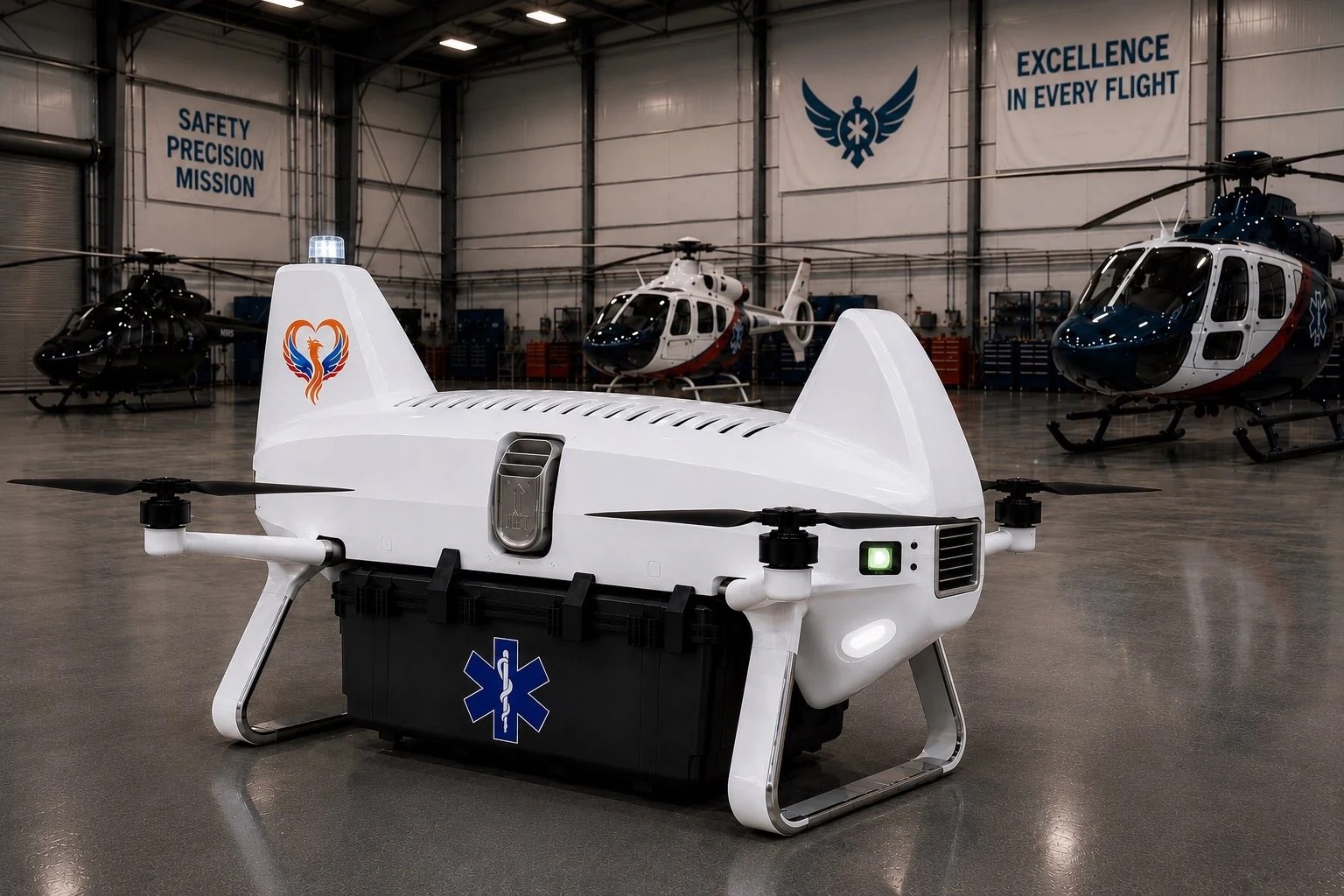
Phoenix cargo drone inside a medical aviation hangar

MEDICAL LOGISTICS

Between road delay and helicopter cost.

A dedicated aircraft layer for time-sensitive movement of blood, pharmaceuticals, laboratory materials, devices, and emergency supplies between institutional sites.

Interfacility routes Controlled custody Runway independent

Primary customer

Multi-hospital health systems, laboratories, blood networks, specialty pharmacies, and rural referral relationships.

Priority payloads

  • Blood and blood products
  • Laboratory specimens
  • Pharmaceuticals and medical devices

Route types

  • Hospital-to-hospital corridor
  • Central laboratory network
  • Regional and rural hub-and-spoke

Operating requirements

  • Temperature, shock and custody monitoring
  • Site, airspace, weather and contingency controls
  • Dispatch, maintenance and exception workflows

Value created

Predictable delivery windows, faster clinical decisions, inventory balancing, resilience, and reduced dependence on premium couriers or oversized crewed aviation.

Proof required

Safety, mission completion, on-time delivery, time advantage, payload integrity, availability, full cost per mission, and customer conversion evidence.
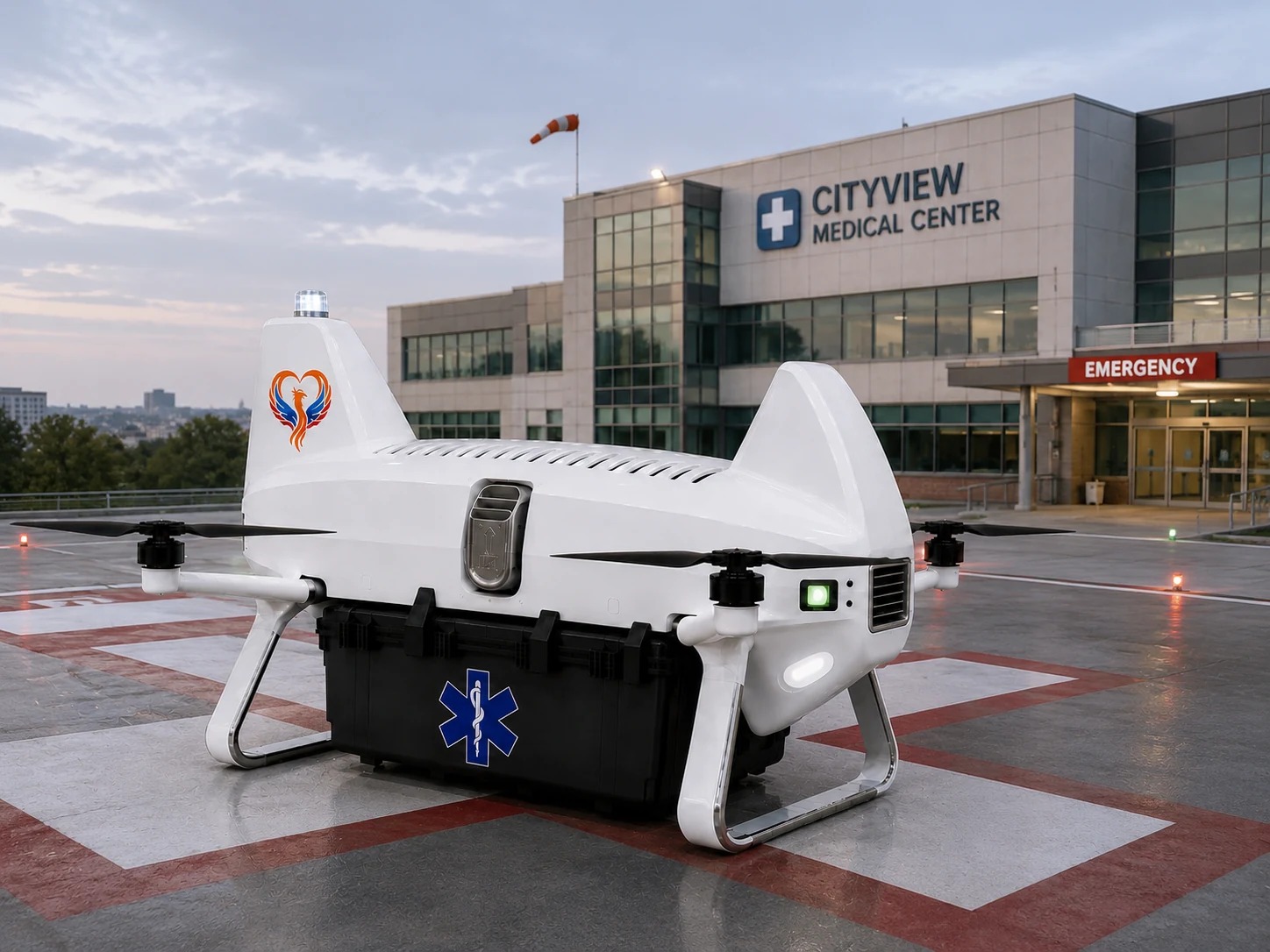
Phoenix P1 — candidate commercial configuration

One core architecture.
Modular missions.

Phoenix is developing a fixed-wing VTOL cargo platform with distributed lift, a central fuselage, modular payload interfaces, autonomous flight controls, and remote operational supervision.

The aircraft, payload module, ground station, communications, maintenance system, and fleet software are engineered as one operating system—not disconnected products.

50–200 lbCandidate useful payload band
50–150 nmiCandidate mission radius
VTOLCompact-site runway independence
Discuss a route or partnership
Phoenix medical cargo drone concept on a hospital landing site
01MODULAR PAYLOAD
02DISTRIBUTED LIFT
03FIELD-READY LANDING

Planning bands are candidate requirements for engineering trade studies—not demonstrated specifications, sales commitments, or certification claims.

Aircraft concept laboratory

Different missions.
Shared design DNA.

Explore conceptual aircraft directions carried forward from Phoenix design work. The commercial program will select and simplify configurations around validated customer routes.

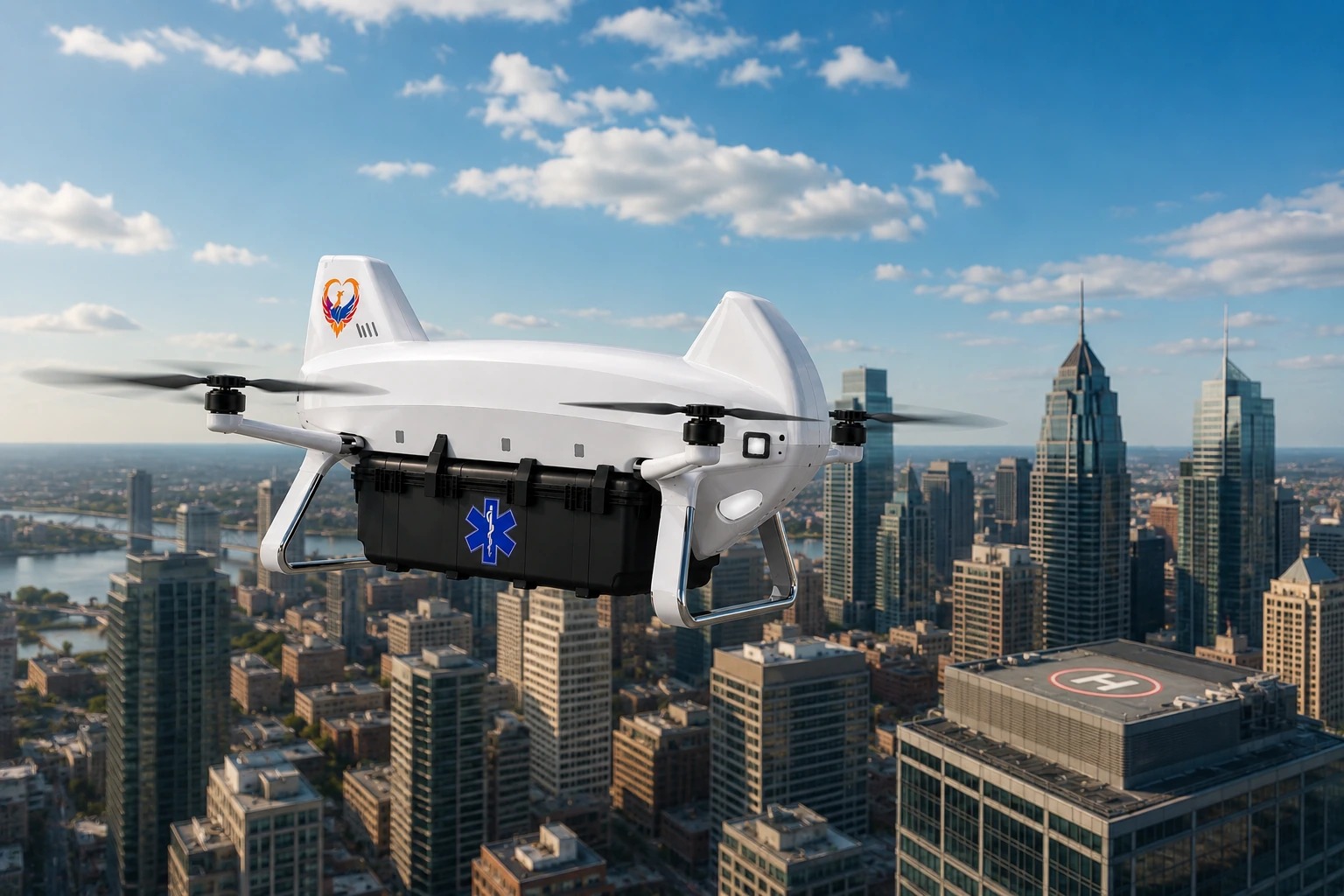
Phoenix P1 medical logistics aircraft flying above a major city
P1 / CRITICAL MEDICAL LOGISTICSCONCEPT VIEW

INITIAL COMMERCIAL CONFIGURATION

Purpose-built around the route.

The P1 is a medical-logistics system with modular payloads, controlled custody, maintenance support, fleet software, route integration, and remote supervision.

Candidate payload50–200 lb
Candidate radius50–150 nmi
Primary marketHealthcare
ModelSale · lease · service

Evidence required

  • Validated customer route, payload and site requirements
  • Approved operating, safety and maintenance concept
  • Paid pilot with objective conversion criteria
  • Released configuration, supplier evidence and financeable unit economics

P1 advances to commercial deployment only after customer, flight, supplier, regulatory, reliability, and economic evidence supports the decision.

P1Critical Medical LogisticsInitial commercial configuration Phoenix P1 medical logistics aircraft flying above a major city

INITIAL COMMERCIAL CONFIGURATION

Purpose-built around the route.

The P1 is a medical-logistics system with modular payloads, controlled custody, maintenance support, fleet software, route integration, and remote supervision.

Candidate payload50–200 lb
Candidate radius50–150 nmi
Primary marketHealthcare
ModelSale · lease · service

Evidence required

  • Validated customer route, payload and site requirements
  • Approved operating, safety and maintenance concept
  • Paid pilot with objective conversion criteria
  • Released configuration, supplier evidence and financeable unit economics

P1 advances from demonstrator to commercial configuration only after customer, flight, supplier, regulatory, reliability, and economic evidence supports the decision.

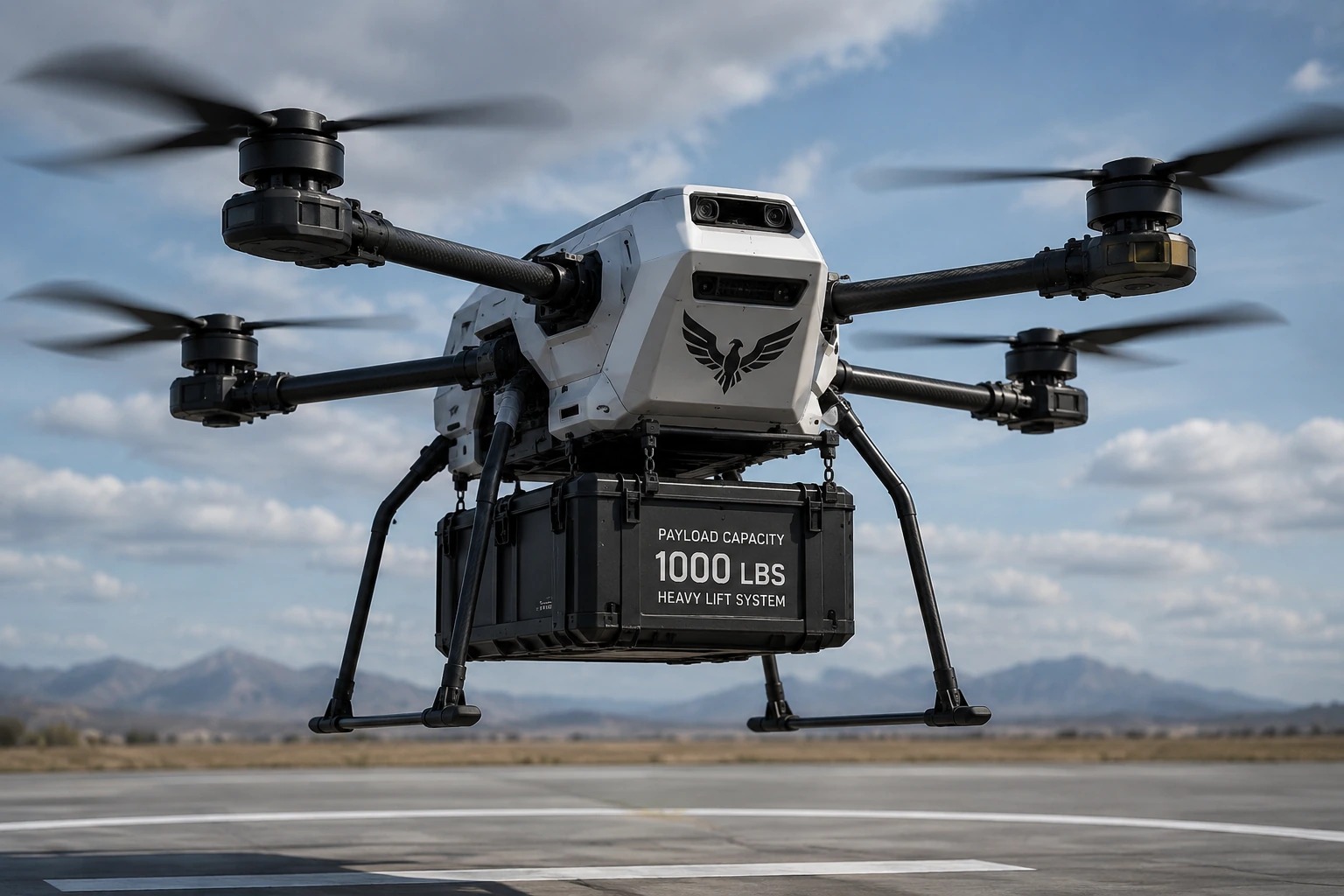
P2Regional Cargo VariantExtended payload and range Phoenix P2 regional cargo heavy-lift aircraft carrying a 1,000-pound payload

EXTENDED PAYLOAD AND RANGE

Earn the regional variant.

The P2 is intended for regional hub-and-spoke, rural access, emergency logistics, and larger medical-equipment missions using common architecture wherever P1 evidence supports reuse.

Candidate payload200–1,000 lbs
Candidate radius100–300 nmi
RoleRegional cargo
Advance whenP1 data matures

Evidence required

  • P1 flight, reliability and maintenance data
  • Verified customer demand and route economics
  • Reusable suppliers, avionics, software and support systems
  • Capital and certification plan proportionate to the expanded envelope

P2 is not a seed-stage clean-sheet program. It advances only when P1 has created a reusable engineering, supplier, customer, and operating basis.

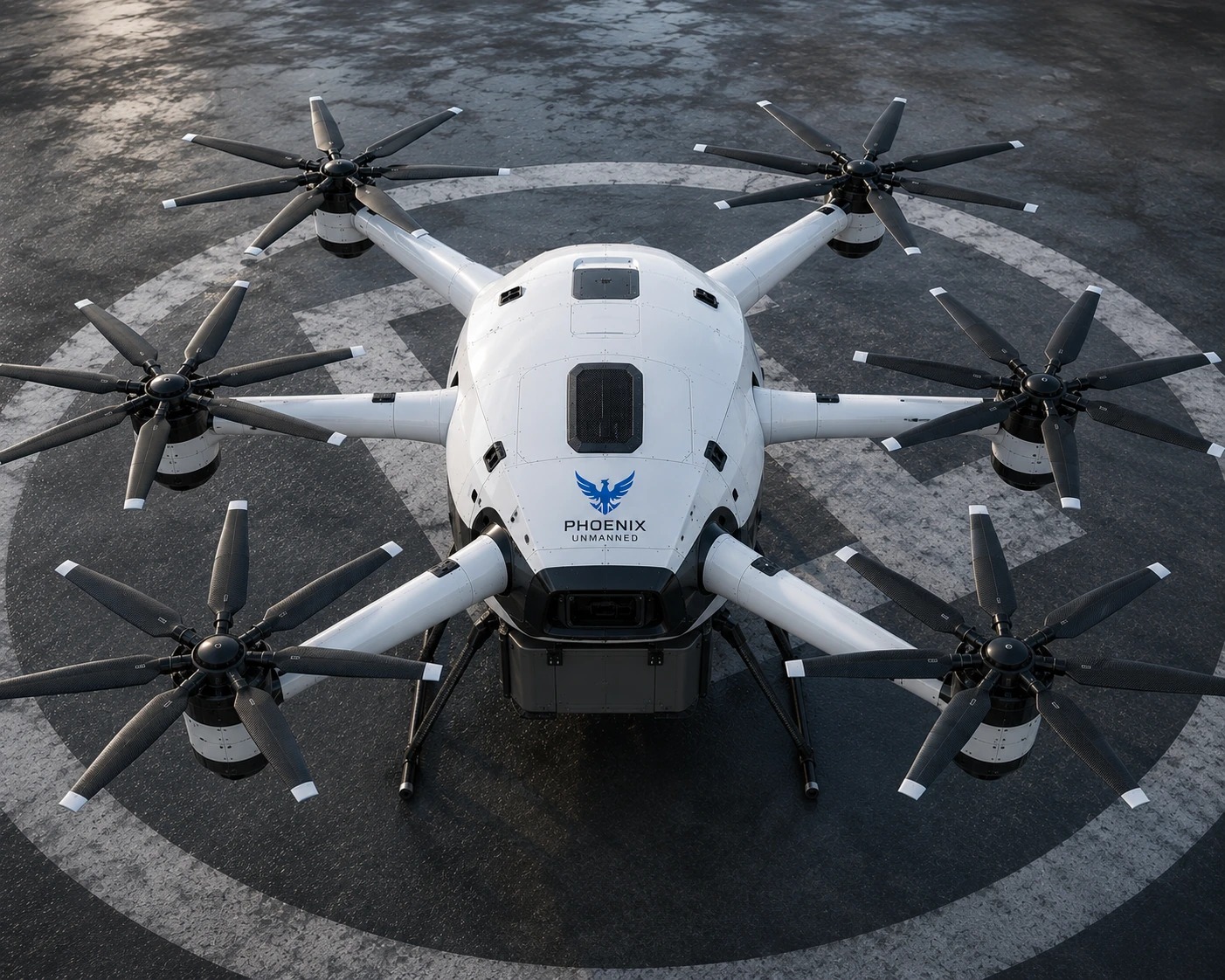
P3Heavy-Lift DevelopmentLater specialized product family Phoenix P3 heavy-lift aircraft concept viewed from above on a landing pad

LATER SPECIALIZED PRODUCT FAMILY

Heavy cargo after the core is proven.

The P3 is a mission-dependent family for austere, disaster, defense, and specialized heavy cargo—advanced only after the core medical and regional platforms are proven.

Candidate payload1,000–2,000 lbs
Candidate radiusMission-dependent
RoleHeavy cargo
StatusLater-stage

Evidence required

  • Demonstrated P1/P2 safety, operations and customer adoption
  • Named, funded mission and qualification pathway
  • Heavy-lift propulsion, structure, energy and ground-support evidence
  • Dedicated capital outside the seed-stage P1 program

Heavy-lift development begins only after smaller-platform evidence, a funded mission, and a proportionate technical, regulatory, manufacturing, and financing plan are in place.

The Phoenix technology stack

Aircraft are the visible layer.
Dependability is the real product.

01

Payload integration

Modular cargo boxes, controlled-environment concepts, secure restraint, custody monitoring, and customer-specific interfaces.

02

VTOL architecture

Runway-independent lift combined with efficient cruise, compact-site operations, and configuration trade studies grounded in route requirements.

03

Autonomy & supervision

Mission planning, flight controls, communications, health monitoring, contingency behavior, and remote operational oversight.

04

Digital traceability

Requirements, software versions, serial numbers, tests, maintenance, payload records, and field events connected in a controlled system.

05

Maintainability

Accessible inspections, line-replaceable units, diagnostics, serialized components, spares, and field support designed into the aircraft.

06

Cyber & supply trust

Protected command, software, configuration, customer data, maintenance interfaces, and disciplined third-party component control.

The logistics gap

Right-sized aviation for
missions that cannot wait.

Phoenix does not seek to replace every truck or helicopter. It creates a priority logistics layer for urgent payloads where access, safety, speed, and predictable delivery windows matter.

GROUND

Familiar and scalable

  • Ideal for bulk and multi-stop delivery
  • Constrained by traffic and damaged infrastructure
  • Exposes drivers in high-risk environments
CREWED AVIATION

Powerful and flexible

  • Essential for rescue, medevac, and heavy lift
  • Higher crew, cost, noise, and scheduling burden
  • Often oversized for routine critical cargo
Phoenix route network concept A conceptual network linking hospitals, a laboratory, an emergency site, and an operations center. HOSPITAL A OPERATIONS CORE HOSPITAL B RESPONSE SITE PHOENIX ROUTE SYSTEM / CONCEPT VIEW

A route is the product

Aircraft are only one part
of dependable service.

Phoenix integrates route engineering, site readiness, payload qualification, controlled custody, mission release, remote supervision, maintenance, safety evidence, customer reporting, and continuous improvement.

01Design the routeValidate payload, sites, economics, weather, airspace, and contingency needs.
02Prove the systemUse progressive ground, payload, communications, site, and flight validation.
03Operate under controlTrace every configuration, release, mission, maintenance action, and exception.
04Expand with evidenceIncrease payload, range, weather envelope, and autonomy only when data supports it.

Research library

Mission thinking
before mission hardware.

Phoenix white papers frame operational need, customer value, route considerations, and the role of unmanned aircraft alongside established logistics systems.

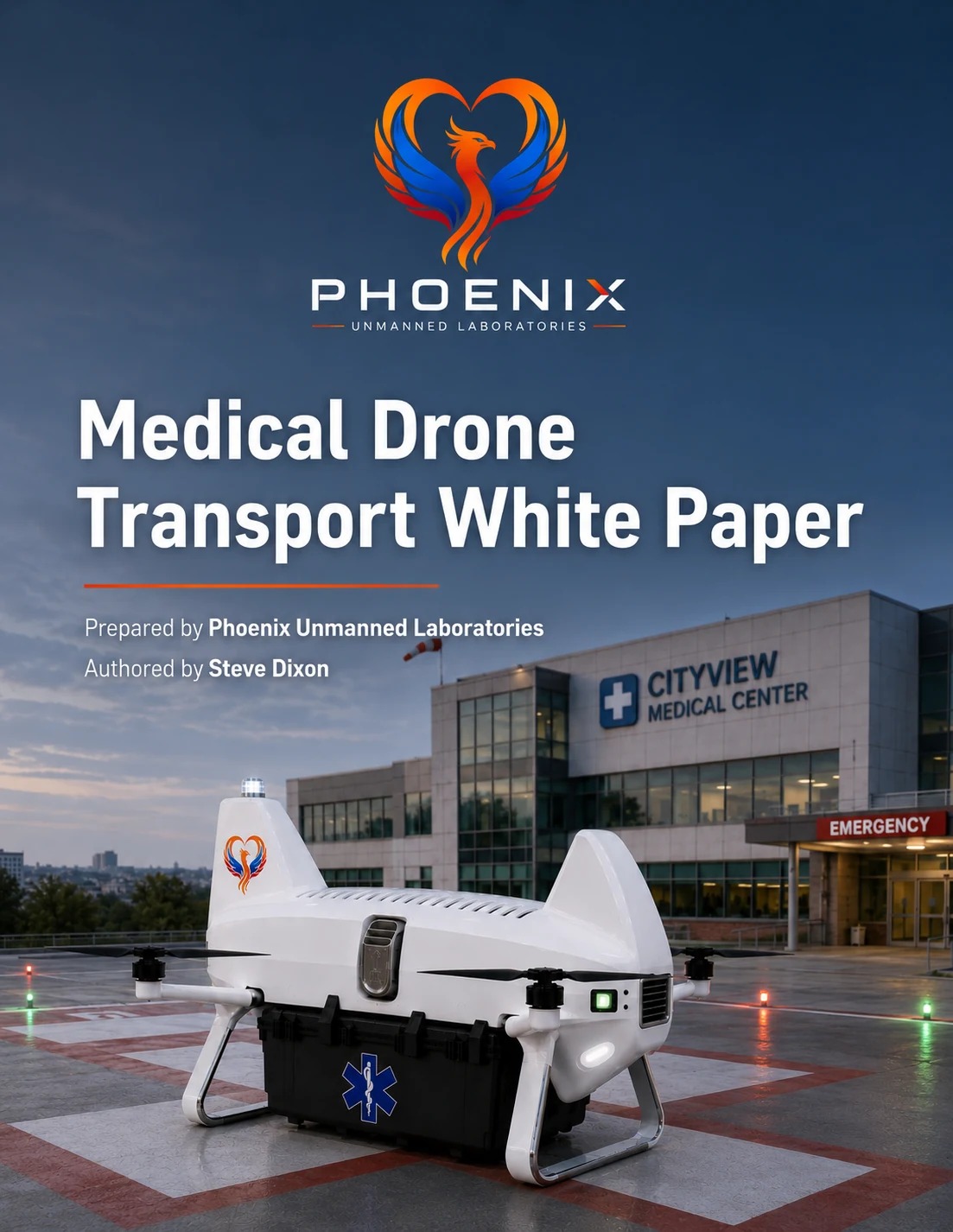
Medical Drone Transport white paper coverOPEN PDF ↗

WHITE PAPER 01

Medical Drone Transport

Medical supplies, equipment, pharmaceuticals, blood products, specimens, and transplant-related materials across healthcare networks.

Download white paper
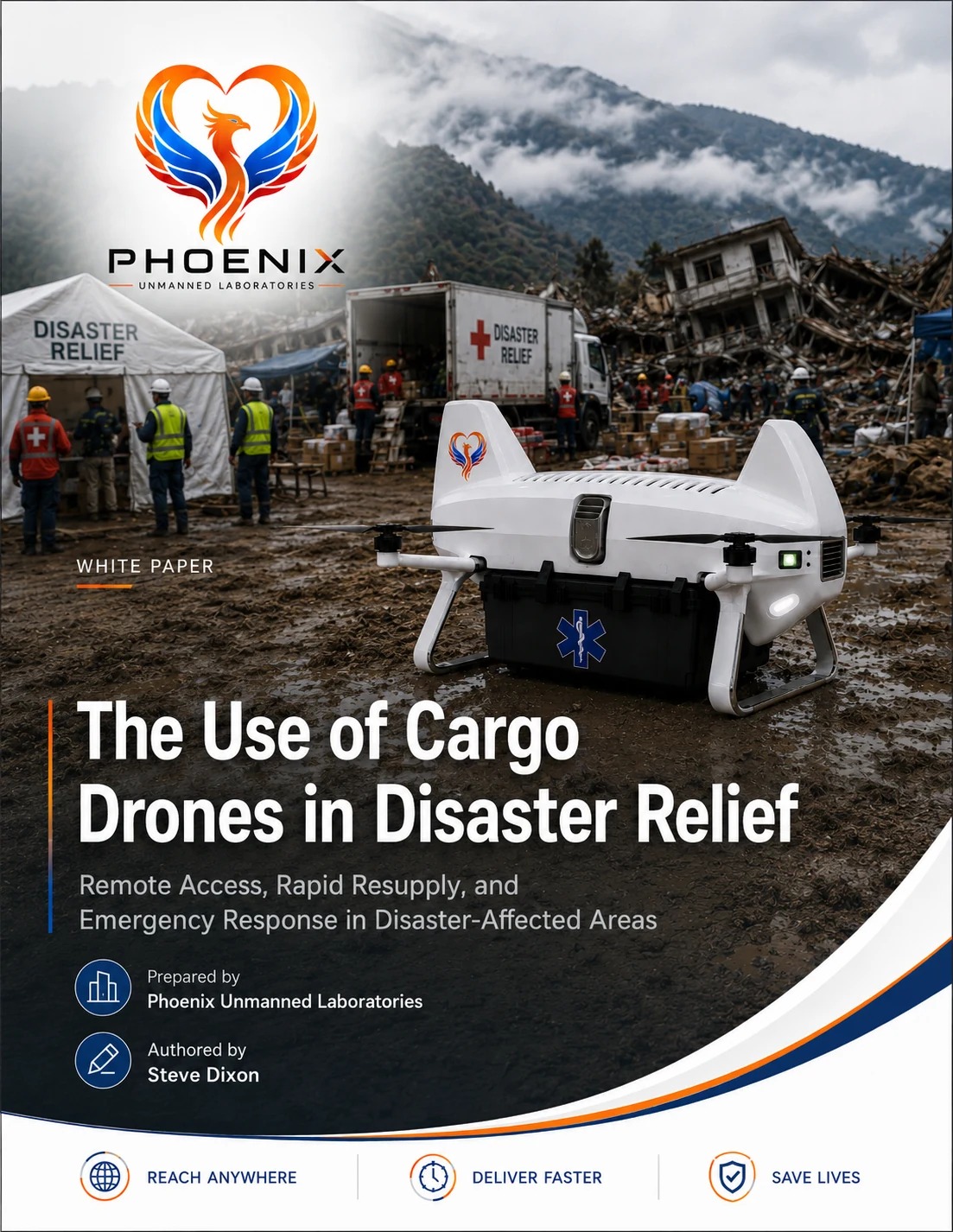
Cargo Drones in Disaster Relief white paper coverOPEN PDF ↗

WHITE PAPER 02

Cargo Drones in Disaster Relief

First-wave resupply for responders, field clinics, shelters, and isolated communities when surface access is disrupted.

Download white paper
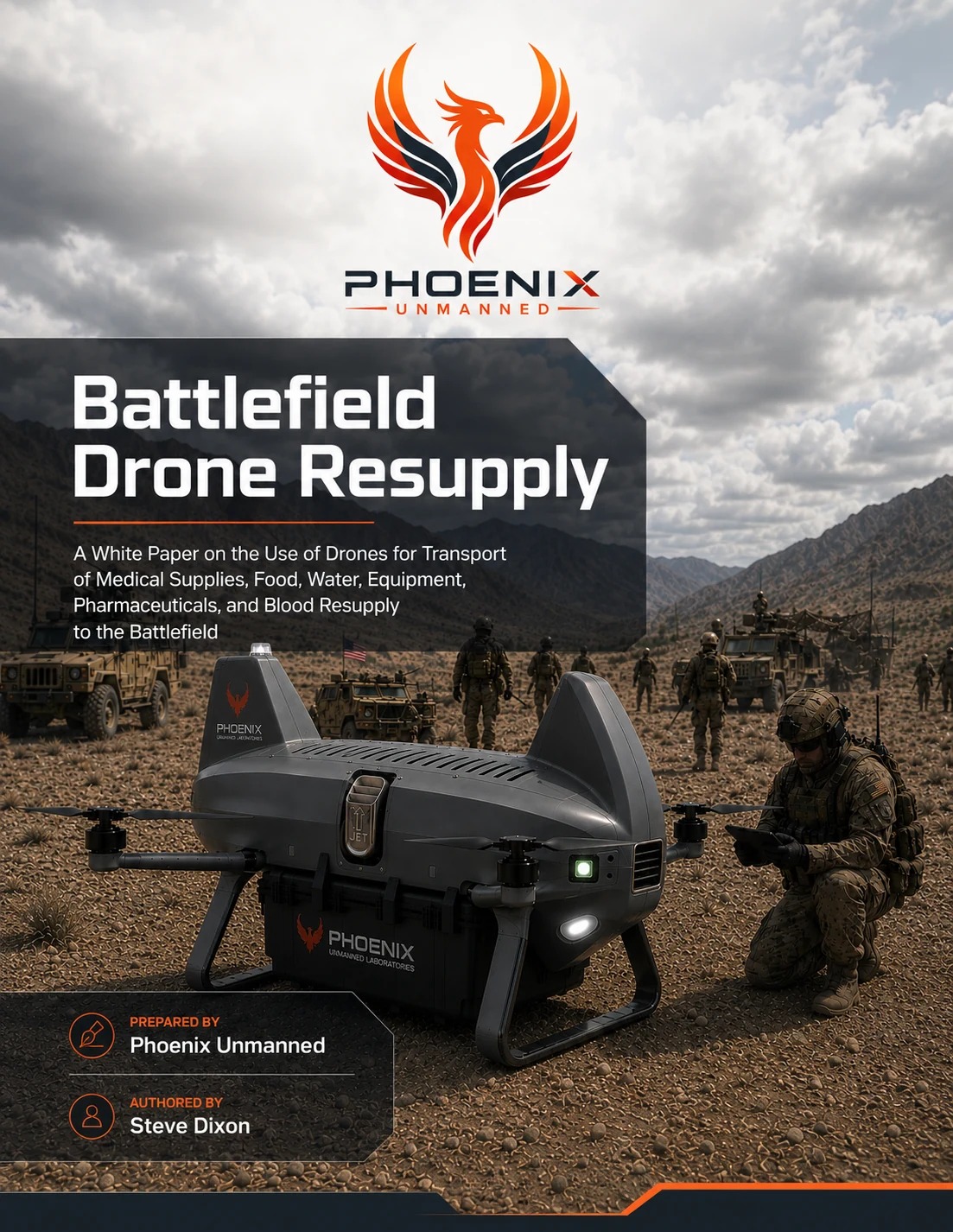
Battlefield Drone Resupply white paper coverOPEN PDF ↗

WHITE PAPER 03

Battlefield Drone Resupply

Non-weaponized transport of medical supplies, food, water, equipment, pharmaceuticals, blood, and sustainment cargo.

Download white paper

Markets served

Built for organizations
that cannot wait.

01

Hospitals & health systems

Urgent logistics between facilities, laboratories, pharmacies, blood banks, and distribution sites.

02

Emergency management

Critical supply movement after storms, floods, earthquakes, wildfires, and infrastructure disruption.

03

Rural communities

Medical and emergency access where distance, terrain, or limited infrastructure slows conventional transport.

04

Humanitarian organizations

Relief supply delivery into remote, damaged, or difficult-to-reach regions.

05

Defense logistics

Non-weaponized medical and sustainment resupply for austere and selected support environments.

2026–2030 strategic path

Build credibility
one gate at a time.

The program advances through evidence-based gates—customer requirements, configuration selection, ground test, flight validation, paid pilots, route reliability, and controlled scale.

Define & build

Customer discovery, route requirements, architecture trade study, supplier qualification, demonstrator build.

Fly & validate

Ground campaign, envelope expansion, payload integrity testing, reliability learning, regulatory data package.

Pilot & prove

Paid institutional pilot, route integration, service-level measurement, maintenance and operating refinement.

Repeat & expand

Additional routes, disciplined low-rate production, recurring support, software, and maintenance revenue.

Scale the platform

Regional network growth and controlled evolution toward larger mission variants after P1 evidence matures.

Founder-led aircraft development

“I don’t pitch concepts.
I build aircraft that fly.”

Steve Dixon has worked in unmanned-aircraft development since 2013. Phoenix carries forward a builder’s culture: stay humble, protect the mission, learn from evidence, and never allow commercial pressure to override safety.

Steve DixonFounder & CEO
MISSION ABOVE PROFITALL FOR ONEHELP THE PEOPLE
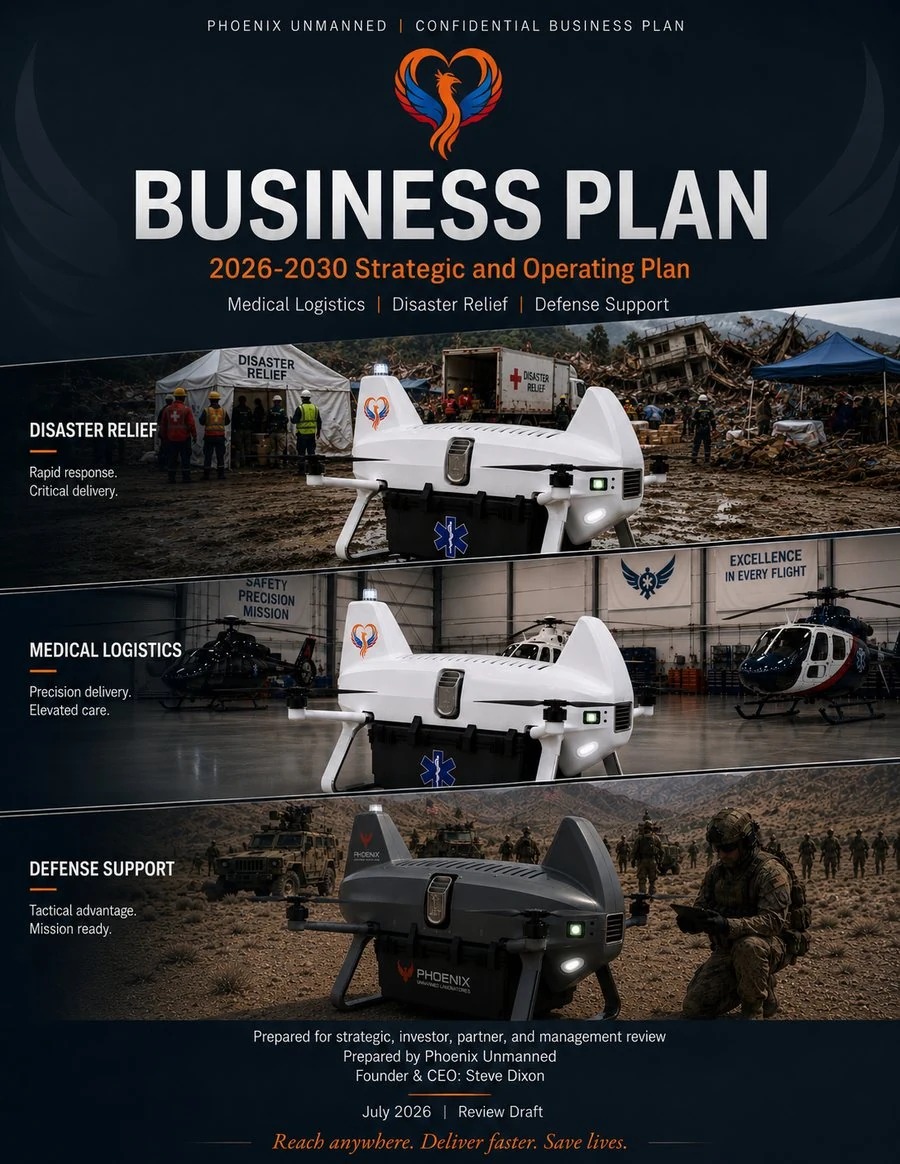
Phoenix Unmanned 2026–2030 Business Plan cover

The complete operating thesis

From aircraft concept
to durable enterprise.

The Phoenix Unmanned business plan brings together market strategy, product architecture, commercialization, manufacturing, safety, regulation, intellectual property, organization, milestones, funding, and risk.

  • Medical-logistics launch market
  • Aircraft and product roadmap
  • Route economics and commercialization
  • Operations, safety, quality, and regulatory strategy
  • Competition, IP, team, milestones, and financial plan

Customers · partners · investors · builders

Help build what
comes next.

Phoenix is seeking mission-aligned health systems, aviation and logistics partners, suppliers, technical talent, advisors, and investors who believe critical cargo deserves a dedicated aircraft layer.

Design partnerStrategic partnerInvestorSupplierTeam
DIRECT EMAIL[email protected]

Reach anywhere. Deliver faster. Save lives.

SECURE INQUIRY CHANNELPHX-CONTACT-01